Patient Care Goals
Provision of care while maintaining safety for the patient, EMS personnel, and others.
Assessment
| Pediatric Pearls: | Signs & Symptoms: | Differential: |
| □ Use approved reference document for medication dosing, electrical therapy, and equipment sizes. □ Parents may know what de-escalation techniques have worked in the past | □ Anxiety, agitation, confusion □ Affect change, hallucinations □ Delusional thoughts, bizarre behavior □ Expression of suicidal homicidal thoughts □ Tachycardia, diaphoresis, tachypnea □ Struggles violently despite appropriate restraints □ Combative / violent □ Very “hot” to touch | □ Refer to Altered Mental Status □ Hypoglycemia □ Hypoxia □ Alcohol intoxication □ Medication effect / overdose □ Withdrawal syndromes □ Bipolar (manic-depressive) □ Schizophrenia, anxiety disorders, etc. □ Hypertensive emergency □ Seizure / Postictal □ Domestic Violence or Abuse |
Clinical Management Options
| EMT-B |
| • Oxygen target SpO2 92% – 96% • Check a blood glucose • Basic Airway Management as needed • Physical restraint if needed and use Restraint Checklist • Never transport a restrained patient in a prone position on a stretcher • Cooling measures if needed • Consider transportation to an Alternative Destination if the patient is a) not intoxicated and b) voluntary and willing to go |
| Paramedic |
| • Vascular access as appropriate for patient condition • Fluid therapy as needed with Isotonic Isotonic Crystalloid, preferred cold if excited delirium • Cardiac monitor and 12 ECG • Consider sedation for agitated patients; document a pre-sedation RASS and a RASS after medications have been provided • RASS +3/+4 Ketamine is preferred • RASS +1/+2 Midazolam or Droperidol is preferred (consider droperidol in patient’s with concern for airway compromise) • Consider lower dosing in patients who are elderly (65yo+) or acutely intoxicated • If the patient is suspected of excited delirium and suffers cardiac arrest, then consider a fluid bolus and Sodium Bicarbonate early |
Richmond Agitation Sedation Score (RASS)
| +4 | Combative | Overly combative or violent and an immediate danger to provider |
| +3 | Very Agitated | Aggressive, non-combative or pulls on or removes tube(s) or catheter(s) |
| +2 | Agitated | Frequent, non-purposeful movement or patient/ventilation desynchrony |
| +1 | Restless | Anxious or apprehensive, movements not aggressive or vigorous |
| 0 | Alert and Calm | Spontaneously pays attention to provider |
| -1 | Drowsy | Not fully alert but sustains more than 10 seconds wake, with eye opening in response to verbal command |
| -2 | Light Sedation | Awakens briefly for less than 10 seconds with eye contact or verbal command |
| -3 | Moderate Sedation | Any movement, except eye contact, in response to command |
| -4 | Unarousable | No response to voice or physical stimulation |
Restraints Checklist
| □ All other calming attempts have failed, which include at minimum verbal de-escalation and/or reduced stimulation. □ Adequate personnel to effect restraint, with consideration to include law enforcement. □ Place patient in supine position restrained with 1 arm up and 1 arm down, unless clinically contraindicated. □ Law enforcement must be immediately available if handcuffed. □ EMS personnel in constant attendance. □ Chemical sedation administered, if required. □ Continuous EtCO2, SpO2, ECG, and vital sign monitoring. □ Continuous assessment of neurovascular status every 15 minutes, which includes pulse, motion, sensation in all extremities. □ Adequate personnel for transport. □ Excited delirium is considered. □ Physical and/or chemical restraints reviewed on a periodic basis. □ Above documented fully in ePCR, including: Efforts prior to restraint, Time of restraint, Chemical sedation, Continuous monitoring, Neurovascular status evaluation |
Alternative Destination
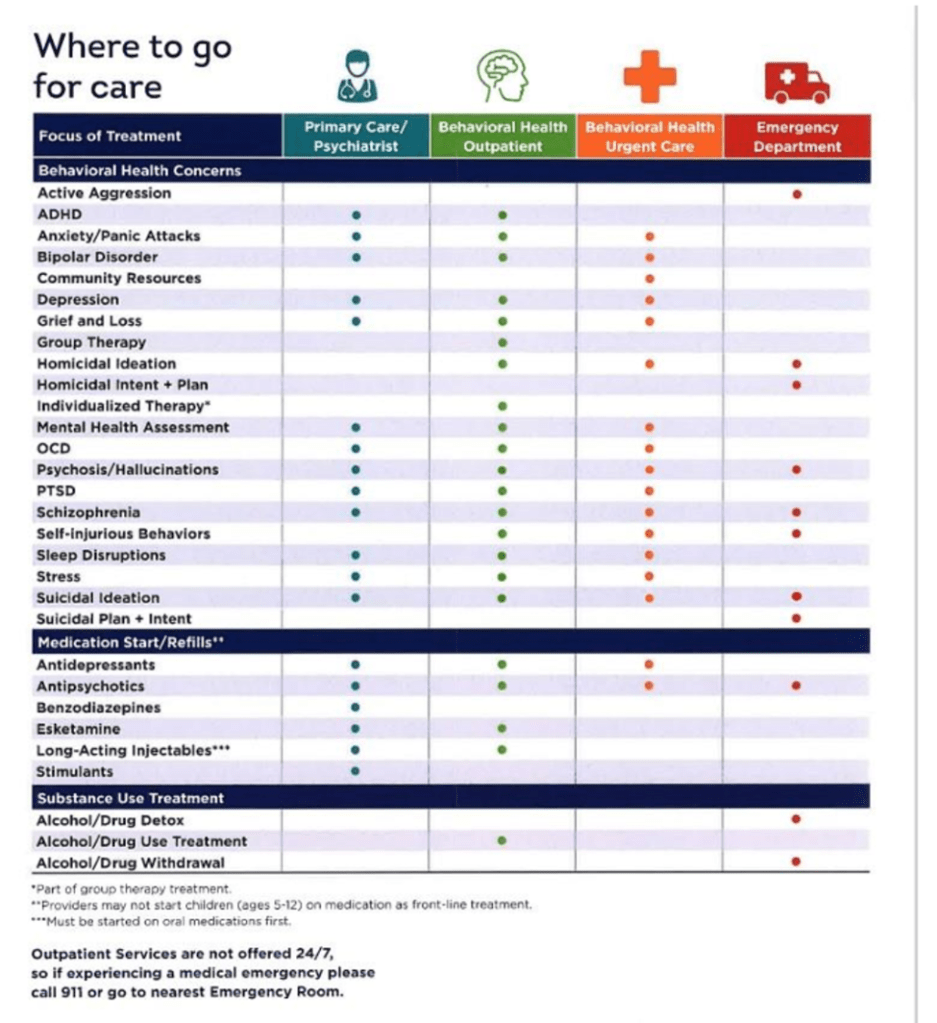
Alternative Destination to SSM (DePaul or SLUH) may be considered in patient who are 18 years old or older with:
- Symptoms of anxiety, depression, grief reaction, hallucinations
- Self-injurious behavior without need for medical evaluation
- Need for medication adjustment
- Request for psych or counselling therapy
- Patients who feel they are in crisis and seeking counseling/intervention
- They consent to transport to SSM Behavior Health Urgent Care
- *Pediatric patients (anyone less than 18) need a parent to transport to with the patient, parents must be ok taking the patient back home
Alternative Destination to SSM (DePaul or SLUH) should not be considered in patients with:
- SI or HI with intent, plan, and means
- Affidavit or 96-hour old order
- Aggressive patients or patients who require sedation
- Anyone under the influence of drugs or alcohol
- Anyone in withdrawal from alcohol or other substance
- Overdose in the last 48 hours
- Anyone who has medical needs that need to be addressed
- Patient is presenting from an inpatient facility
SSM Process Monday – Saturday, 0900 – 1800
- EMS crew calls BHUC to give report of patient
- a. DePaul Phone number: 314-344-7200
- b. SLUH Phone number: 314-257-7430
- c. If needed, caller can request to speak with a nurse
- d. Gives report of patient presentation
- EMS arrives at Behavioral Health Urgent Care
- EMS takes patient to the main entrance of the BHUC without a stretcher
- a. EMS should not enter through the ambulance doors
- i. Patient needs to go through metal detector and the registration process before being brought into the treatment area.
- a. EMS should not enter through the ambulance doors
- Patient is escorted to the registration kiosks to begin registration process.
- EMS Crew will be badged into the treatment area so that report can be given.
- Nurse or Nurse Practitioner will receive report and sign required EMS documents.
- EMS will exchange dirty linen for clean linen if needed.
- EMS exits and process ends.
Pearls
- Consider your safety first. Physical restraint should be performed / assisted by Law Enforcement when available.
- Be sure to consider all possible medical and/or trauma causes for behavior.
- Consider transporting to the Behavioral Urgent Care in calm patients. DO NOT TRANSPORT TO THE URGENT CARE IF THE PATIENT IS A FLIGHT RISK.
- All patients who receive either physical or chemical restraint must be continuously observed by ALS personnel on scene or immediately upon their arrival.
- Any transported patient who is handcuffed or restrained by Law Enforcement should be accompanied by an officer whenever possible and if not, then law enforcement must be immediately available.
- Restrained patients must never be maintained or transported in a prone position.
- SAVE Mnemonic for De-Escalation:
- Support – “Let’s work together…”
- Acknowledge – “I see this has been hard for you…”
- Validate – “I would probably be reacting the same way if I was in your shoes…”
- Emotion naming – “You seem upset…”
- Excited Delirium (EXD) is interchangeable with Excited Delirium Syndrome (ExDS), both refer to a condition where the patient continues to struggle violently despite appropriate restraint that results from a combination of delirium, psychomotor agitation, anxiety, hallucinations, speech disturbances, disorientation, violent and bizarre behavior, insensitivity to pain, elevated body temperature, and superhuman strength. Therefore, underlying etiologies of EXD/ExDS must be considered:
- Metabolic / Endocrine – hypoxia, electrolyte abnormalities, hepatic encephalopathy, hypercarbia, hyper/hypoglycemia, thyrotoxicosis, uremia
- Neurologic – dementia, head injury, encephalitis, post-ictal state/seizure
- Psychiatric – acute psychosis, mania, medication stoppage, personality disorder, schizophrenia
- Infectious/Inflammatory – autoimmune encephalitis, herpes encephalitis, meningitis, sepsis
- Toxicologic – alcohol, amphetamines, cocaine, neuroleptic malignant syndrome, PCP, polypharmacy, serotonin syndrome, synthetic cannabinoids, synthetic cathinones
- Cold isotonic crystalloid boluses 30 ml/kg with temperature > 104 F up to 2 liters in adults.
- Blood samples for performing glucose analysis should be obtained through a finger-stick (heel for infants).
- Droperidol can cause akisthesia (need to move) or torticollis. The treatment for both of these side effects is IV/IM Benadryl.