
Patient Care Goals
Provision of care while maintaining safety for the patient, EMS personnel, and others.
Patient Care Goals
| Assessment | ||
| Pediatric Pearls: | Signs & Symptoms: | Differential: |
| □ Use approved reference document for medication dosing, electrical therapy, and equipment sizes. □ Parents may recognize when their child is behaving abnormally | □ Confused, repetitive questions □ Nauseated □ Headaches □ Very “hot” to touch | □ Concussion □ TBI □ Heat exhaustion □ Heat Stroke |
| EMT-B |
| • Check a temperature • Obtain a GCS score • Ask questions about the game (what’s the score, inning/quarter of the game) • Maintain C-spine stabilization if a patient has been knocked out or complaining of neck pain • Splint any painful joints and provide ice |
| Paramedic |
| • Vascular access as appropriate for patient condition • Fluid therapy as needed with Isotonic Crystalloid, preferred cold if overheated • Cardiac monitor and 12 ECG if syncope during activity • If the patient suffers cardiac arrest, then consider a fluid bolus and Sodium Bicarbonate early |
Consult Medical Control as needed
Pearls
- EMS does not determine if the patient can return to play. We are there for illness and concern. Clearance is performed by the patient’s primary care doctor vs Emergency Department
- For complaints not listed, please refer to 911 Protocols and Guidelines
- Concussion
- Concussion is common in contact sports, with football having the highest incidenceCommon symptoms are nausea, vomiting, headaches, and loss of balance/coordinationLoss of consciousness occurs in only 10% of cases. Do not assume that there is no concussion if there has been no loss of consciousness
- Patient who have lost consciousness are assumed to have a spinal injury
- Spinal concerns
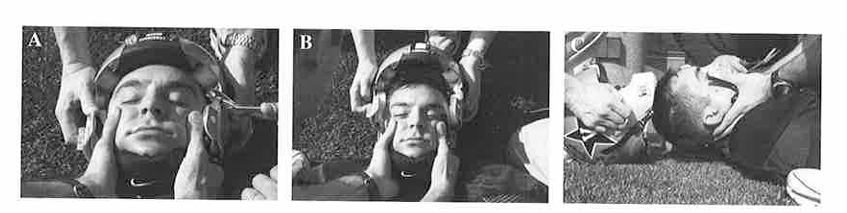
- Patients who are altered should be assumed to have a concern for spinal injury. Equipment should be removed while maintaining in-line C-spine support and a C-collar should be placed.
- Syncope and Sudden Cardiac arrest
- Syncope during or right after activity is concerning. This may be a sign of undiagnosed Brugada or other genetic channel mutation
- All syncope patient’s need an EKG and an evaluation.
- The most common initial rhythm is Vfib/Vtach in sports cardiac arrest. Place pads early in the arrest.
- Consider fluids and bicarb, especially in summer sports
- Heat Illness
- Consider heat illness early in young athletes with fatigue, vomiting, lightheadedness
- Check a temperature in patients where there is a concern
- Give fluids and start cooling rapidly if temperature is elevated

