

A – Adults. B – Children
Percentage of Total Body Surface Area by Age, Anatomic Structure, and Body Habitus
| Adult | |
| Anatomic Structure | Surface Area |
| Anterior head | 4.5% |
| Posterior head | 4.5% |
| Anterior torso | 18% |
| Posterior torso | 18% |
| Anterior leg, each | 9% |
| Posterior leg, each | 9% |
| Anterior arm, each | 4.5% |
| Posterior arm, each | 4.5% |
| Genitalia, perineum | 1% |
| Adult – Obese 80 kg |
|
| Anatomic Structure | Surface Area |
| Head and neck | 2% |
| Anterior torso | 25% |
| Posterior torso | 25% |
| Leg, each | 20% |
| Arm, each | 5% |
| Genitalia/perineum | 0% |
| Child | |
| Anatomic Structure | Surface Area |
| Anterior head | 9% |
| Posterior head | 9% |
| Anterior torso | 18% |
| Posterior torso | 18% |
| Anterior leg, each | 6.75% |
| Posterior leg, each | 6.75% |
| Anterior arm, each | 4.5% |
| Posterior arm, each | 4.5% |
| Genitalia/perineum | 1% |
| Infant 10 kg |
|
| Anatomic Structure | Surface Area |
| Head and neck | 20% |
| Anterior torso | 16% |
| Posterior torso | 16% |
| Leg, each | 16% |
| Arm, each | 8% |
| Genitalia/perineum | 1% |
Parkland Formula
For patients who require fluid resuscitation, consider use of the Parkland formula to calculate the volume of normal saline or lactated Ringer’s solution that should be administered intravenously to ensure hemodynamic stability.
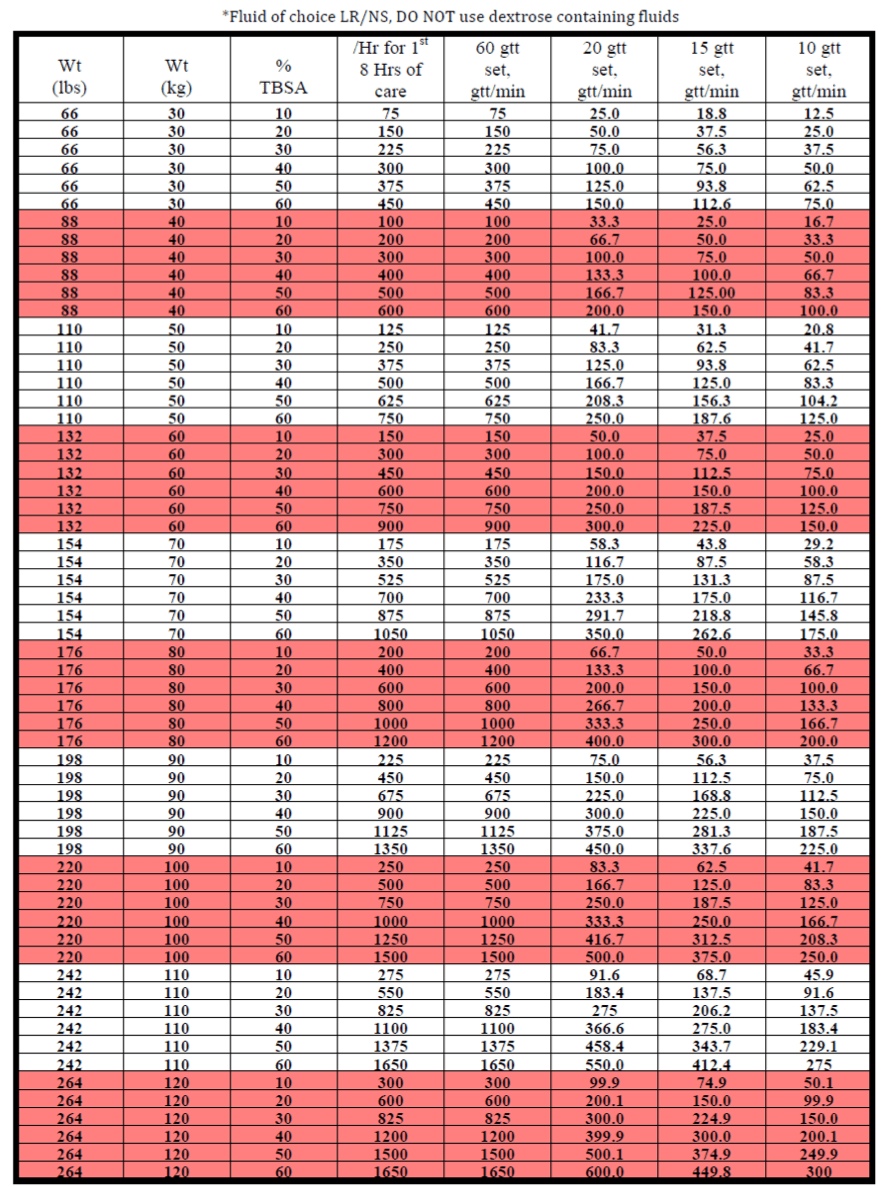
Volume of Intravenous Fluid required in the first 24 hours (in mL) = (4 X patient weight in kg) X (Percentage of total body surface area burned)
The first half of the volume of fluid should be administered over the first 8 hours following the burn with the remaining fluid administered over the following 16 hours.
For pediatric patients, a weight-based assessment tool (length-based tape or other system) should be used to provide a more accurate estimate of the patient’s weight. Likewise, the total body surface area (BSA) estimates are different for pediatric patients compared to adults due to larger head and trunk size. For children, the palmar surface of the hand (not including the fingers is approximately equal to 1% BSA. The guidelines listed above will provide assistance during the estimation of the percentage of total body surface area burned for patients of various ages and body habitus.
Burn Injury IV Fluid Rates
Infusion Rate Weight > 30 KG
Infusion Rate Weight < 30 KG

Source: Used with permission, University of Utah Burn Center (https://crisisstandardsofcare.utah.edu).
 CHEMS Field Treatment Guidelines